
Introduction
Since the beginning of the twentieth century, a disused clay pit near the village of Barnham, Suffolk, was known to contain artefacts from the Lower Palaeolithic. Initial excavations took place between 1989 and 1994, producing artefact assemblages and floral and faunal remains dating to the Hoxnian Interglacial, approximately 400,000 years ago. Modern excavations have taken place since 2013, partially run as a three-week student field school each summer.
Go straight to:

Research Aims
The research for the Barnham excavations is focused on three main areas: re-investigation of handaxe and non-handaxe lithic assemblages, interpreting evidence of fire, and documenting the flora and fauna at the site:
1. Reinvestigation of Handaxe/Non-Handaxe Assemblages
We are reinvestigating two different lithic assemblage types at the site — one without handaxes (Clactonian) and one with handaxes (Acheulian). Research during the 1990s concluded that both assemblage types were found in similar deposits at different parts of the site and were therefore at least geologically contemporary.

The favoured interpretation was that the same group of people was responsible for both assemblages, but with different activities and tools in the two areas.
A more complex picture is emerging through our recent fieldwork, which re-examines the evidence with improved resolution of the geology. It seems that the non-handaxe assemblage is slightly earlier than the handaxe assemblage, and that two separate human populations are represented.
This leads to questions such as:
- What is the time gap between the occupations?
- Can different populations be identified at other sites of this age?
- Were different hominin species responsible for the different industries?
- Can other technological differences be identified?
2. Interpreting Evidence of Fire Making
We have been investigating human fire-use since 2013, when abundant quantities of heat-shattered flint were discovered in the new Area VI, in addition to very occasional fragments of charcoal from other areas of the site. The question was whether this represented a natural wildfire or humanly controlled fire. Of interest was that some of the earliest evidence of human fire use in Europe was found at nearby Beeches Pit, also dating to around 400,000 years ago.
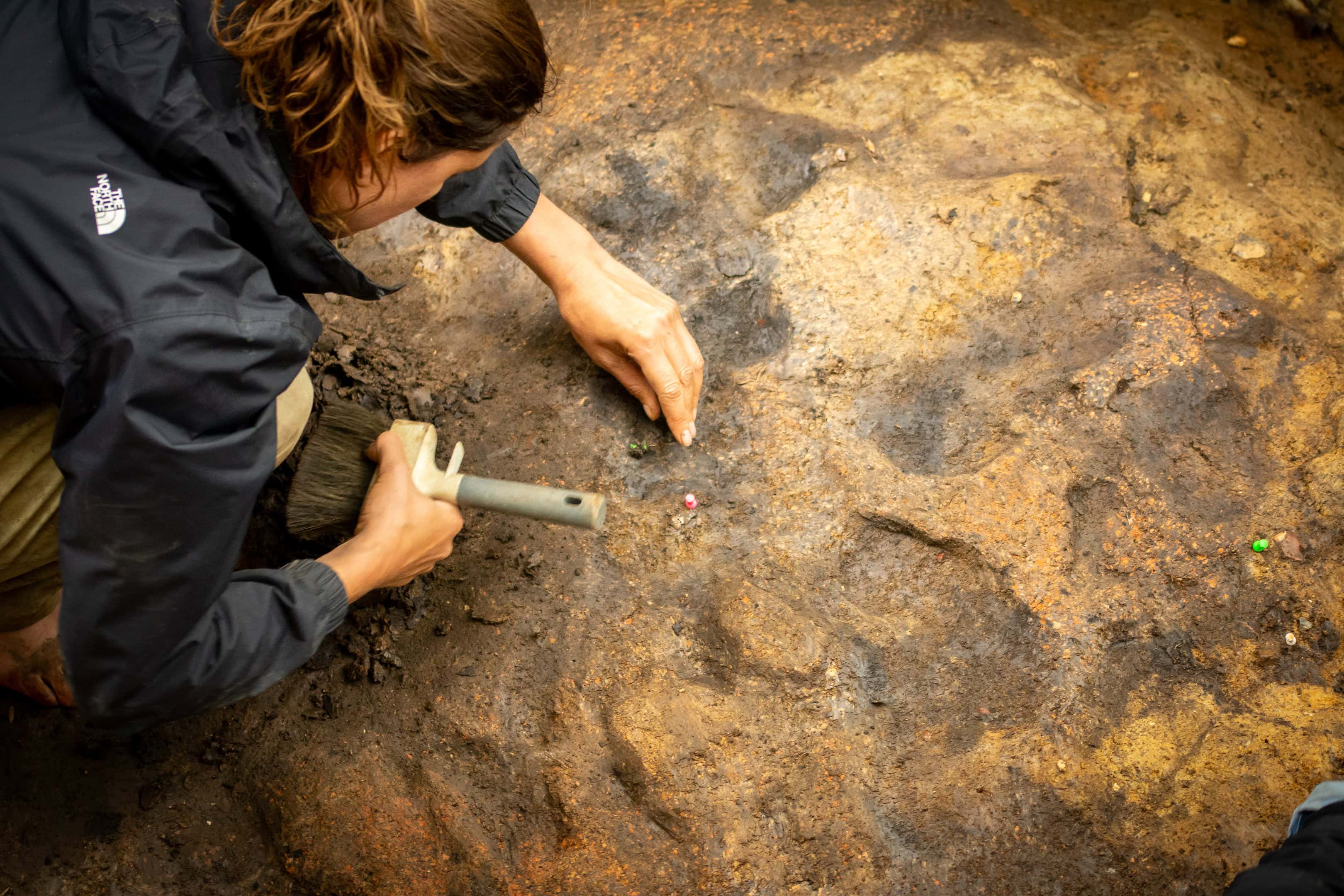
In 2021, we discovered the first strong clue with what appeared to be heated sediment – an isolated patch of reddened clay. It has taken four years to carefully excavate and use geochemical tests to convincingly demonstrate that the reddening was caused by repeated heating events, and strong evidence of a campfire.
In addition, heat-shattered handaxes were found nearby, as well as two tiny fragments of iron pyrite, a naturally occurring iron mineral. Pyrite in later periods was used to strike against flint to create sparks for igniting tinder. Geological studies demonstrate that pyrite is incredibly rare around Barnham, and the only time we find it, is in association with heated handaxes and a hearth – it seems that humans were bringing pyrite to the site with the intention of making fire.
Making fire is a major turning point in early human evolution. There is no longer dependence on harvesting natural fires and allows regular use, where and when you want it. Besides warmth and protection, it enables improved digestion through cooking, freeing up energy for development of the brain, and provides a social hub after dusk.
For detailed information about the interpretation of fire making at Barnham, please see the page Fire 400 ka, the related blog posts, or the paper published in Nature in 2025, Earliest evidence of making fire.
3. Documenting Flora and Fauna
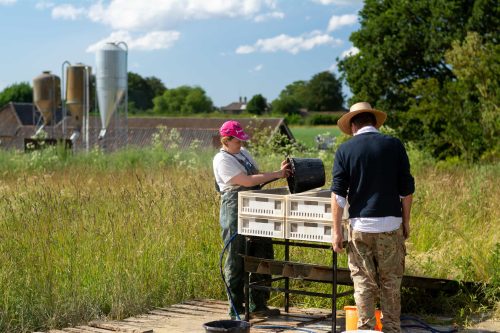
A final aim is to increase our knowledge of the floral, molluscan and vertebrate assemblages recovered at East Farm.
Barnham is one of the richest sites in Britain for amphibians and reptiles, with exotic species such as tree frogs and European pond terrapins. There are also exotic mammals, including extinct species of rhinoceros and elephant.
A large-scale extraction and sieving programme has begun and the results are adding to our understanding of the area’s fauna. We are also using new pollen analyses to learn more about the local vegetation.
Barnham Timeline
1700s: The earliest indications of clay digging at East Farm, the pit becomes the main source of bricks for the Euston Estate
1880s: The pit is shown (as a “Gravel Pit”) on 1st edition Ordnance Survey (OS) map, with the brickworks located on the eastern edge of Barnham village (NGR TL 876792), by what is now Salmond Drive.
1891: The pit is mentioned in the Old Series Geological Survey Memoir for Ely, Mildenhall and Thetford.

1900s: The enlarged pit is shown as a “Clay pit” on the OS map. Bricks made from clay extracted from East Farm pit are used to rebuild Euston Hall after it was damaged by fire in 1902.
1913: First published report of Palaeolithic artefacts from Barnham by Clarke in the Proceedings of the Prehistoric Society of East Anglia, also including a description of the deposits in the brick pit.
1930s: Last clay extraction takes place at East Farm pit.
1933-36: TT Paterson conducts excavations at East Farm Barnham as part of his study of the geology and archaeology of the Breckland. Findings published in the Proceedings of the Prehistoric Society of East Anglia in 1937.
1979: John Wymer cuts a section in the pit, locating the cobble surface and finding a refitting group of 13 flakes and a core.
1989: A reconnaissance visit to East Farm in February to explore the potential for further research is followed by a week’s fieldwork which established areas for larger scale excavation.
1990-94: Five seasons of fieldwork take place at East Farm, Barnham, directed by Nick Ashton (British Museum). By the end of the excavations, three archaeological areas had been excavated; Area I, Area IV(4) and Area V and in another part of the site Area III had been excavated to recover faunal material. Papers were published in the Journal of the Geological Society and in Antiquity.
1998: Publication of results of the 1989-94 excavations as a British Museum Occasional Paper; Excavations at the Lower Palaeolithic Site at East Farm, Barnham: 1989-94.
2000: The Quaternary Research Association visits East Farm as part of its Annual Field Meeting. TimeTeam broadcasts an episode featuring the nearby site at Elveden and also including Barnham.
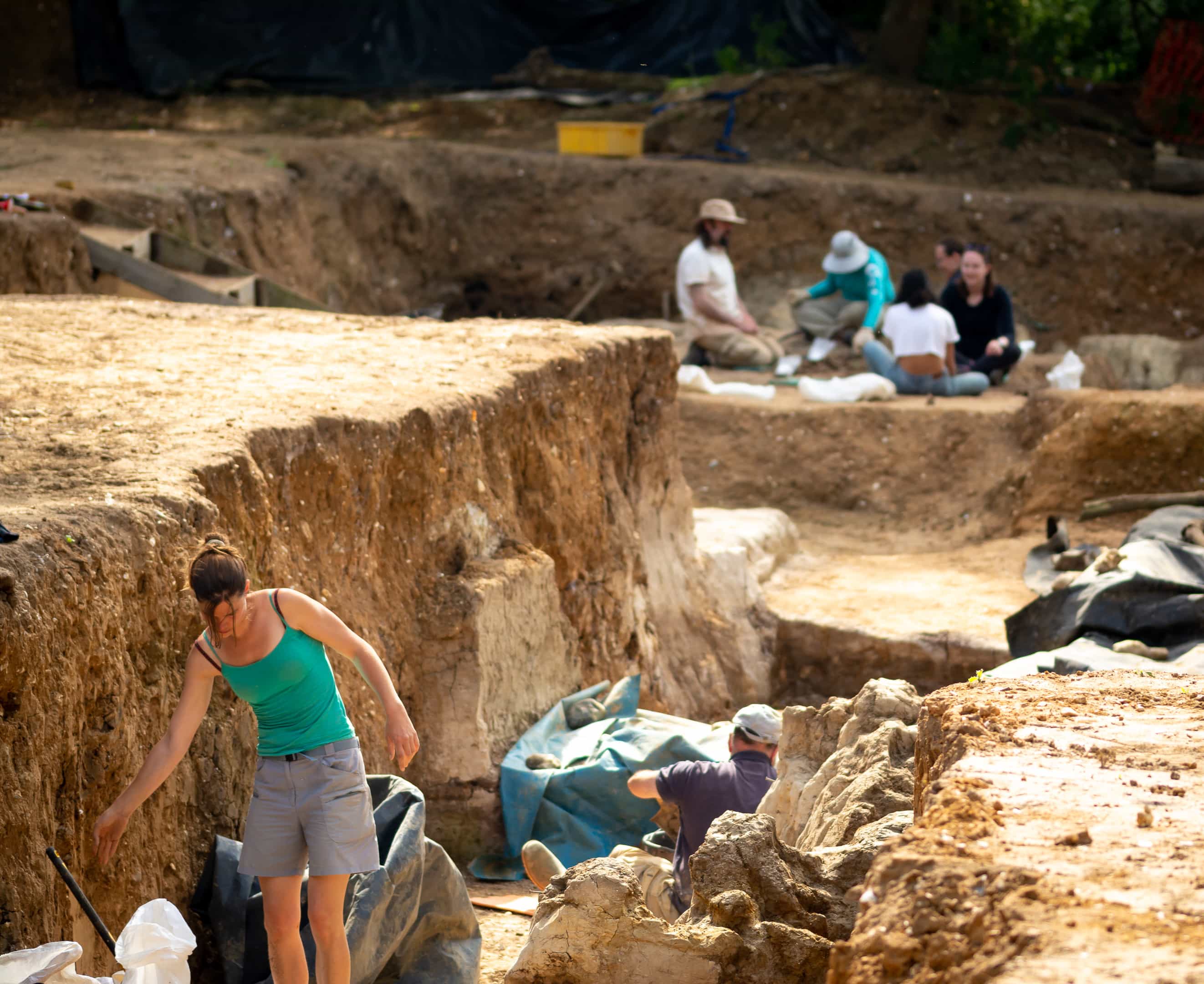
2013: Excavations recommence at East Farm, again led by Nick Ashton. A group of eight students from Leiden University join the research team to establish a new archaeological area (Area VI) in the southeast corner of the pit and the faunal area (Area III) is relocated and enlarged.
2014-19: Six seasons of fieldwork undertaken at East Farm, with students from Leiden as well as several UK universities. Major excavations in Areas III and VI have yielded hundreds of lithic artefacts, numerous fauna remains and new geological information with first publication in Journal of Quaternary Science.
2020: No excavations owing to COVID-19.
2021: Three weeks of excavations in June/July focused on Area III continued the excavation, sampling and sieving of these deposits in preparation for further work next year. In addition, a number of boreholes were drilled to establish the distribution of the sediments within and beyond the pit. Finally, and of potential great interest, a small patch of reddened sediment was found to the east of Area I – the new Area I East. The reddened clay has the characteristics of heated clay.
2022: A three-week season brought the major phase of work in Area III to a conclusion, with detailed excavation of sediments and sampling for charcoal analysis, and also bulk sampling of deeper deposits to investigate their faunal content. The focus in Area I East was further investigation of the reddened clay and evidence of fire, in particular trying to find the extent of the reddened clay, and sampling for geochemical analyses.
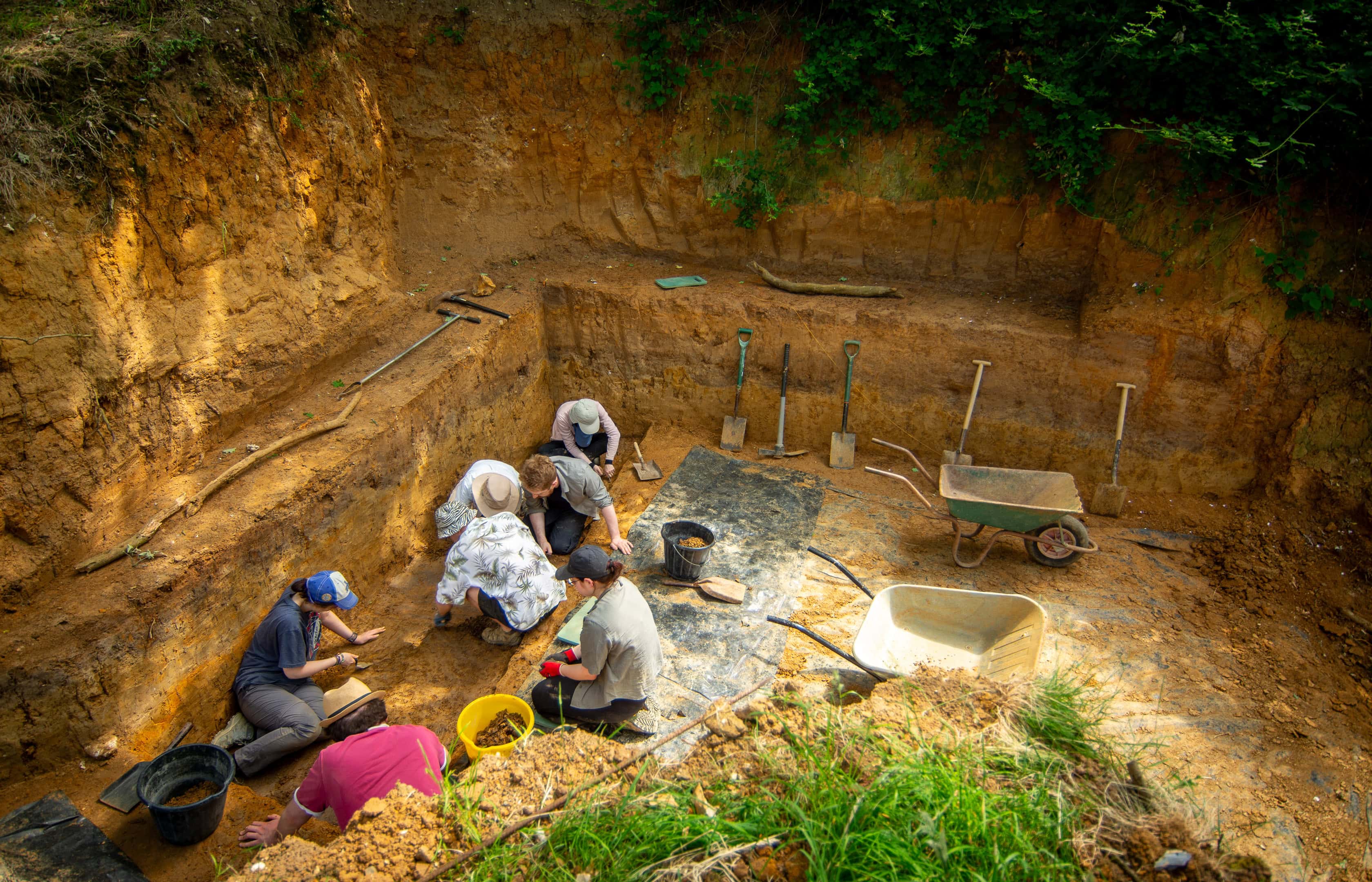
2023: This year there was further exploration of the fire evidence in Area I East, and excavation of a larger area to link this with the old Area I excavation. Now that the extent of the reddened clay was better understood, excavation began of two diagonally opposite quadrants to provide sections through the potentially heated sediment. Further work re-examined Pit 4 and the western edge of Area III to show the lateral changes in the sediments from the centre to the edge of the basin.
2024: The focus this year was entirely on Area I East with completion of the two quadrants through what is now been confirmed to be heated sediment. The linking excavation to the old Area I also continued with the discovery of a surprising number of heat-shattered flint, including handaxes.
2025: This has been the final season with just two weeks of work, when we completed all the Area I East excavations. This led to the publication in the science journal Nature, entitled ‘Earliest Evidence of Making Fire’ in December 2025.
Publications & Further Reading
Ashton, N.M. (2017). Early Humans. HarperCollins, London.
Ashton, N.M., Lewis, S.G. & Parfitt, S.A. (Eds) (1998). Excavations at Barnham, 1989-94. British Museum Occasional Paper 125, London.
Ashton, N., Lewis, S. G., Parfitt, S. A., Davis, R. J., & Stringer, C. (2016). Handaxe and non‐handaxe assemblages during Marine Isotope Stage 11 in northern Europe: recent investigations at Barnham, Suffolk, UK. Journal of Quaternary Science, 31(8), 837-843.
Davis, R.J, Hatch, M., Hoare, S., Lewis, S.G., Lucas C., Parfitt, S.A., Bello, S.M., Lewis, M., Mansfield, J., Najorka,J., O’Connor, S., Peglar, S., Sorensen, A., Stringer, C.B., Ashton, N.M. (2025). Earliest evidence of making fire. Nature.
Davis, R. J., Lewis, S. G., Ashton, N. M., Parfitt, S. A., Hatch, M. T., & Hoare, P. G. (2017). The early Palaeolithic archaeology of the Breckland: current understanding and directions for future research. The Journal of Breckland Studies, 1, 28-44.
Gowlett, J. A. J., Hallos, J., Hounsell, S., Brant, V., & Debenham, N. C. (2005). Beeches Pit–archaeology, assemblage dynamics and early fire history of a Middle Pleistocene site in East Anglia, UK. Eurasian Prehistory, 3(2), 3-38.
Preece, R. C., Gowlett, J. A., Parfitt, S. A., Bridgland, D. R., & Lewis, S. G. (2006). Humans in the Hoxnian: habitat, context and fire use at Beeches Pit, West Stow, Suffolk, UK. Journal of Quaternary Science: Published for the Quaternary Research Association, 21(5), 485-496.
Preece, R. C., & Penkman, K. E. H. (2005). New faunal analyses and amino acid dating of the Lower Palaeolithic site at East Farm, Barnham, Suffolk. Proceedings of the Geologists’ Association, 116(3-4), 363-377.
Wymer J.J. (1985). Palaeolithic Sites of East Anglia. Geo Books, Norwich.
Contributors
- Nick Ashton (British Museum)
- Simon Lewis (Queen Mary University of London)
- Simon Parfitt (Natural History Museum & University College London)
- Rob Davis (British Museum)
- Peter Hoare (Queen Mary University of London, deceased)
- Claire Lucas (British Museum)
- Marcus Hatch (Queen Mary University of London)
- Claire Harris (MOLA and Queen Mary University of London)
- Simon O’Connor
- Jordan Mansfield
- Tudor Bryn Jones
- Sophie Hunter
- Joshua Hogue
- Craig Williams