Skip to navigation Skip to content
Pathways to Ancient Britain
  • Media Usage
  • Privacy Policy
  • Home
  • About
    • About Pathways to Ancient Britain
      • Overview
      • Pioneering Populations: 1 million-500,000 years ago
      • Successful Colonisers: 500,000-300,000 years ago
      • Emerging Neanderthals: 240,000-40,000 years ago
    • Project Team
    • In Memory of Peter Hoare
  • News
  • Research Projects
    • Barnham Excavations
      • Project Summary
      • Blog Posts
      • Excavation Photos
        • Excavation Photos 2025
        • Excavation Photos 2024
        • Excavation Photos 2023
        • Excavation Photos 2022
        • Excavation Photos 2019
        • Excavation Photos 2018
        • Excavation Photos 2017
        • Excavation Photos 2016
    • Happisburgh Area
      • Project Summary
      • Blog Posts
      • Resources for Collectors
      • Resources for Schools and Families
      • Events
      • Community
      • Additional Happisburgh Projects
        • North Norfolk Coast Virtual Field Trip
        • Deep History Detectives
        • Palaeolithic Artefact Discoveries from the Sandscaping area (PADS)
    • Breckland Palaeolithic Project
      • Project Summary
    • Fire 400 ka
      • Project Summary
      • Blog Posts
  • Events
    • Being Human 2021: Are Genes Deep History?
  • Publications
  • Contact
  • Home
  • About
    • About Pathways to Ancient Britain
      • Overview
      • Pioneering Populations: 1 million-500,000 years ago
      • Successful Colonisers: 500,000-300,000 years ago
      • Emerging Neanderthals: 240,000-40,000 years ago
    • Project Team
    • In Memory of Peter Hoare
  • News
  • Research Projects
    • Barnham Excavations
      • Project Summary
      • Blog Posts
      • Excavation Photos
        • Excavation Photos 2025
        • Excavation Photos 2024
        • Excavation Photos 2023
        • Excavation Photos 2022
        • Excavation Photos 2019
        • Excavation Photos 2018
        • Excavation Photos 2017
        • Excavation Photos 2016
    • Happisburgh Area
      • Project Summary
      • Blog Posts
      • Resources for Collectors
      • Resources for Schools and Families
      • Events
      • Community
      • Additional Happisburgh Projects
        • North Norfolk Coast Virtual Field Trip
        • Deep History Detectives
        • Palaeolithic Artefact Discoveries from the Sandscaping area (PADS)
    • Breckland Palaeolithic Project
      • Project Summary
    • Fire 400 ka
      • Project Summary
      • Blog Posts
  • Events
    • Being Human 2021: Are Genes Deep History?
  • Publications
  • Contact
Posted on October 28, 2020August 23, 2021 by PAB Editors

Community Beach Sieving Event

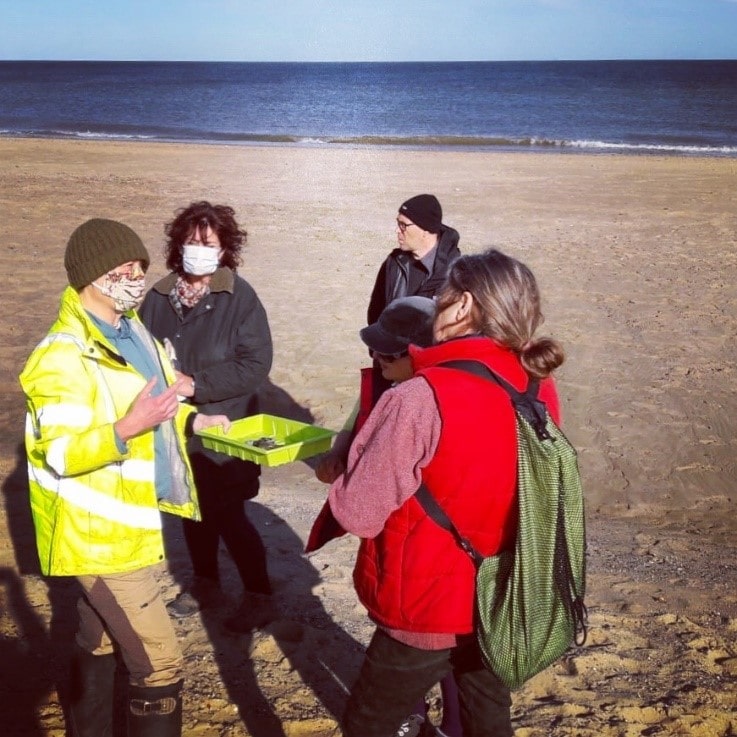
This Sunday saw our first Community Beach Sieving Event at Bacton. The event was planned, with the support of North Norfolk District Council, as part of our Palaeolithic Artefact Discoveries from the Sandscaping area (PADS) Project and we hope that it will be the first of several community events – pandemic permitting.

We couldn’t have hoped for better weather for our first community event and we were joined by two enthusiastic groups of volunteers – a mix of experienced collectors, faces we recognised from previous events that we’d run locally, and some complete beginners.

Since the emplacement of the 1.8 million cubic metres of dredged material on the beach between Bacton and Walcott in 2019, the beach profile has been modified by wave action. As the beach has been reshaped it has become a favourite spot for local collectors to visit and their careful beach walking efforts have been repaid by a large collection of Palaeolithic material. The sieving event was designed to take advantage of the wave cut ‘cliff’ features to study the structure, composition and artefact density of these deposits. Establishing the density of artefacts within these deposits and any variations across the Sandscaping area, provides us with useful data alongside the large number of artefacts that have already been reported.

During the two 90 minute sessions on Sunday we sieved around 2.5 cubic metres of the deposit, this yielded one possible artefact, a small struck flake. While this is a small return for the effort it does point to a sparse presence of artefacts within the beach deposits. It also highlights the value of collecting from the beach surface where artefacts may be more visible and larger surface areas can be searched and does contribute to our knowledge of these dredged deposits.

Although the Sandscaping deposits offer a unique research opportunity we are well aware of the power of the North Sea to reshape the coastline – the ‘cliff’ features in the Sandscaping deposits bear witness to the sea’s power. Many of the Pathways to Ancient Britain project team have worked along this coastline for the best part of two decades and the last thing that we would want to do is to negatively impact the communities we have received so much support from. All the material, bar the one possible artefact, was left on the beach to be redeposited by the waves.

The Palaeolithic Artefact Discoveries from the Sandscaping area (PADS) Project is funded by North Norfolk District Council and is currently set to run for six months, from September 2020 to February 2021.
Categories: Happisburgh, Pathways to Ancient Britain, Public engagement

Post navigation

Previous post: Another Brick in the Wall
Next post: The Happisburgh Handaxe 20 Years On
Search PAB
Recent News & Updates
  • 400,000-year-old Neanderthal Fire-Making Technology December 10, 2025
  • The Quest for Fire December 10, 2025
  • A Big Puzzle: the refitting of a burnt handaxe from Barnham December 10, 2025
  • Summer 2024 excavation at Devereux’s Pit December 10, 2024
Follow @PathwaysAB

PAB is a collaboration between institutions including:

Pathways to Ancient Britain Institution Logos

Home | About | Blog | Barnham Excavations | Happisburgh Area | Contact

Copyright © 2025 Pathways to Ancient Britain Project

© Pathways to Ancient Britain 2025
Privacy PolicyBuilt with Storefront.