Skip to navigation Skip to content
Pathways to Ancient Britain
  • Media Usage
  • Privacy Policy
  • Home
  • About
    • About Pathways to Ancient Britain
      • Overview
      • Pioneering Populations: 1 million-500,000 years ago
      • Successful Colonisers: 500,000-300,000 years ago
      • Emerging Neanderthals: 240,000-40,000 years ago
    • Project Team
    • In Memory of Peter Hoare
  • News
  • Research Projects
    • Barnham Excavations
      • Project Summary
      • Blog Posts
      • Excavation Photos
        • Excavation Photos 2025
        • Excavation Photos 2024
        • Excavation Photos 2023
        • Excavation Photos 2022
        • Excavation Photos 2019
        • Excavation Photos 2018
        • Excavation Photos 2017
        • Excavation Photos 2016
    • Happisburgh Area
      • Project Summary
      • Blog Posts
      • Resources for Collectors
      • Resources for Schools and Families
      • Events
      • Community
      • Additional Happisburgh Projects
        • North Norfolk Coast Virtual Field Trip
        • Deep History Detectives
        • Palaeolithic Artefact Discoveries from the Sandscaping area (PADS)
    • Breckland Palaeolithic Project
      • Project Summary
    • Fire 400 ka
      • Project Summary
      • Blog Posts
  • Events
    • Being Human 2021: Are Genes Deep History?
  • Publications
  • Contact
  • Home
  • About
    • About Pathways to Ancient Britain
      • Overview
      • Pioneering Populations: 1 million-500,000 years ago
      • Successful Colonisers: 500,000-300,000 years ago
      • Emerging Neanderthals: 240,000-40,000 years ago
    • Project Team
    • In Memory of Peter Hoare
  • News
  • Research Projects
    • Barnham Excavations
      • Project Summary
      • Blog Posts
      • Excavation Photos
        • Excavation Photos 2025
        • Excavation Photos 2024
        • Excavation Photos 2023
        • Excavation Photos 2022
        • Excavation Photos 2019
        • Excavation Photos 2018
        • Excavation Photos 2017
        • Excavation Photos 2016
    • Happisburgh Area
      • Project Summary
      • Blog Posts
      • Resources for Collectors
      • Resources for Schools and Families
      • Events
      • Community
      • Additional Happisburgh Projects
        • North Norfolk Coast Virtual Field Trip
        • Deep History Detectives
        • Palaeolithic Artefact Discoveries from the Sandscaping area (PADS)
    • Breckland Palaeolithic Project
      • Project Summary
    • Fire 400 ka
      • Project Summary
      • Blog Posts
  • Events
    • Being Human 2021: Are Genes Deep History?
  • Publications
  • Contact
Posted on July 20, 2021August 23, 2021 by PAB Editors

Deep History Detectives weekend event at Happisburgh 

Over the weekend of 17th-18th July members of the PAB research team, Dr Claire Harris and Professor Simon Lewis, were once again at Happisburgh to run the Deep History Detectives weekend event. This event was the culmination of a five-month project funded by the Centre for Public Engagement at Queen Mary University of London. Through various sessions, it aimed to provide an opportunity for PAB researchers to meet people who were interested in learning more about the important Palaeolithic sites along the Happisburgh coastline, to share their knowledge and skills with participants, and to encourage them to get involved with the work of the Pathways to Ancient Britain team. Around 40 people attended one or more of the sessions which included a full-day flint knapping workshop, a taster knapping workshop, geological walks on the beach, and training in artefact identification and recording. 

The flint knapping workshops and demonstrations were led by experimental archaeologist Dr James Dilley. After an introduction to the basics of flint knapping, the participants were able to get “hands on” and have a go, first to learn how to remove flakes with a hammerstone then, as confidence and proficiency improved, at making a handaxe. Under James’s watchful eye and guidance, all the trainee flint knappers were able to make a handaxe. James also demonstrated other Palaeolithic tool making techniques, including an example of prepared core Levallois working to produce an excellent replica of a Levallois core and flake. The artefact identification session, led by Claire Harris, introduced the participants to the basics of artefact recognition, combining a short practical demonstration, led by James, then transferring this knowledge to look at material collected from the Happisburgh coastline. Participants learnt how to recognise the key features of a humanly-struck flake and how these can be distinguished from either natural percussion or thermally fractured flakes.
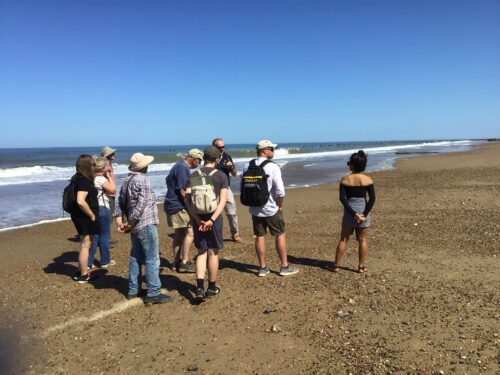
Geology beach walk at Happisburgh
Geology beach walk led by Prof Simon Lewis. Photo: Dr Ian Parker Heath.

For those who wanted to learn more about the geology of the Happisburgh coastline, a geological walk, led by Simon Lewis, introduced the participants to the geological succession that can be seen on the beach at Happisburgh. The unpredictable build-up and removal of sand from Happisburgh beach, conspired to cover up most of the important sediments relating to the archaeological sites at Happisburgh, but it was still possible to tell the story of early humans at Happisburgh and also highlight the importance of on-going work by collectors who visit the area on a regular basis and how this knowledge, when shared with PAB researchers, can add greatly to our understanding of Happisburgh’s archaeological story. There was also the opportunity to discuss the likely impact of movement of material down the coast as a result of the recently-completed Sandscaping project between Walcott and Bacton.  

The main aim of the weekend was to provide new knowledge and skills relating to Happisburgh’s Paleolithic story. It is hoped that, armed with this new knowledge and understanding, our Deep History Detectives will continue to visit the area and be better able understand the geological and environmental evidence that can be seen on the beach and to identify and record Palaeolithic artefacts that can contribute to on-going research on the Happisburgh coastline. 


Categories: Happisburgh, Pathways to Ancient Britain, Public engagement

Post navigation

Previous post: Barnham Excavation Update
Next post: Undiscovered country: Lower Palaeolithic excavations in the Breckland
Search PAB
Recent News & Updates
  • 400,000-year-old Neanderthal Fire-Making Technology December 10, 2025
  • The Quest for Fire December 10, 2025
  • A Big Puzzle: the refitting of a burnt handaxe from Barnham December 10, 2025
  • Summer 2024 excavation at Devereux’s Pit December 10, 2024
Follow @PathwaysAB

PAB is a collaboration between institutions including:

Pathways to Ancient Britain Institution Logos

Home | About | Blog | Barnham Excavations | Happisburgh Area | Contact

Copyright © 2025 Pathways to Ancient Britain Project

© Pathways to Ancient Britain 2025
Privacy PolicyBuilt with Storefront.