Skip to navigation Skip to content
Pathways to Ancient Britain
  • Media Usage
  • Privacy Policy
  • Home
  • About
    • About Pathways to Ancient Britain
      • Overview
      • Pioneering Populations: 1 million-500,000 years ago
      • Successful Colonisers: 500,000-300,000 years ago
      • Emerging Neanderthals: 240,000-40,000 years ago
    • Project Team
    • In Memory of Peter Hoare
  • News
  • Research Projects
    • Barnham Excavations
      • Project Summary
      • Blog Posts
      • Excavation Photos
        • Excavation Photos 2025
        • Excavation Photos 2024
        • Excavation Photos 2023
        • Excavation Photos 2022
        • Excavation Photos 2019
        • Excavation Photos 2018
        • Excavation Photos 2017
        • Excavation Photos 2016
    • Happisburgh Area
      • Project Summary
      • Blog Posts
      • Resources for Collectors
      • Resources for Schools and Families
      • Events
      • Community
      • Additional Happisburgh Projects
        • North Norfolk Coast Virtual Field Trip
        • Deep History Detectives
        • Palaeolithic Artefact Discoveries from the Sandscaping area (PADS)
    • Breckland Palaeolithic Project
      • Project Summary
    • Fire 400 ka
      • Project Summary
      • Blog Posts
  • Events
    • Being Human 2021: Are Genes Deep History?
  • Publications
  • Contact
  • Home
  • About
    • About Pathways to Ancient Britain
      • Overview
      • Pioneering Populations: 1 million-500,000 years ago
      • Successful Colonisers: 500,000-300,000 years ago
      • Emerging Neanderthals: 240,000-40,000 years ago
    • Project Team
    • In Memory of Peter Hoare
  • News
  • Research Projects
    • Barnham Excavations
      • Project Summary
      • Blog Posts
      • Excavation Photos
        • Excavation Photos 2025
        • Excavation Photos 2024
        • Excavation Photos 2023
        • Excavation Photos 2022
        • Excavation Photos 2019
        • Excavation Photos 2018
        • Excavation Photos 2017
        • Excavation Photos 2016
    • Happisburgh Area
      • Project Summary
      • Blog Posts
      • Resources for Collectors
      • Resources for Schools and Families
      • Events
      • Community
      • Additional Happisburgh Projects
        • North Norfolk Coast Virtual Field Trip
        • Deep History Detectives
        • Palaeolithic Artefact Discoveries from the Sandscaping area (PADS)
    • Breckland Palaeolithic Project
      • Project Summary
    • Fire 400 ka
      • Project Summary
      • Blog Posts
  • Events
    • Being Human 2021: Are Genes Deep History?
  • Publications
  • Contact

Category: Public engagement

Posted on January 31, 2024July 5, 2024 by PAB Editors

Deep History Detectives remixed

Deep History Detectives: Tracking artefacts on the North Norfolk Coast

Back in 2021 PAB researchers ran a Deep History Detectives weekend at Happisburgh. PAB Research Associates, Dr Claire Harris (Museum of London Archaeology) and Dr Rachel Bynoe (University of Southampton) have now secured further funding for a small-scale community project.

North Norfolk is well known for the spectacular discoveries made on the Deep History Coast – the evocative Happisburgh footprints, the awe-inspiring West Runton Mammoth, and countless stone tools.

Local collectors have recovered many thousands of artefacts and fossils along the coast. Working with these local collectors PAB researchers have developed a good understanding of the types of artefacts being recovered. Now we’d like to understand more about how the artefacts move along the coastline – how far do they move and over what timeframe? This new community project will help us to investigate these questions.

Replica artefacts (painted bright pink and labelled with project numbers) will be tracked along the coast using the CITiZAN app. To find out more about getting involved, please see links below.

Earlier research using artefacts found by collectors:

Beach replenishment adds a new dimension to the Palaeolithic story of the Norfolk coast – Pathways to Ancient Britain (pabproject.org)

Coastal curios? A new paper explores recent finds on the beach at Happisburgh  – Pathways to Ancient Britain (pabproject.org)

Get involved

Saturday 24 February, Wenn Evans Centre – Collector consultation and planning day with CITiZAN app training (morning and afternoon sessions, booking required)

Sunday 25 February, Wenn Evans Centre – Family Day with artefact painting and activities (drop-in)

Sunday 10 March – Replica artefacts distributed along coast

Saturday 6 July – Project update (Wenn Evans Centre) followed by a beach walk. Book here.

Ongoing – Found a pink stone? Make it known! If you’re out on the beach between Bacton and Sea Palling you may find one of the replica artefacts. They are all painted pink and labelled with project numbers e.g. DHD001. Please record the location using the CITiZAN app. Once you’ve recorded the location, please leave the replica on the beach so that we can continue to track its journey!

How to record an artefact with the CITiZAN app DHD CITiZAN App

Additional information for the Deep History Detectives project DHD_additional_info_CITiZAN_HS

About the project

Project leads: Dr Rachel Bynoe, University of Southampton and Dr Claire Harris, MOLA.

The current project builds on earlier work undertaken by Claire and Rachel and colleagues from the Pathways to Ancient Britain project. The project is supported by Southampton Institute for Arts and Humanities HEIF Research and Innovation Fund 2023/24 and MOLA (Museum of London Archaeology).
Categories: Happisburgh, Pathways to Ancient Britain, Public engagement
Posted on August 3, 2023August 3, 2023 by Administrator

Beach replenishment adds a new dimension to the Palaeolithic story of the Norfolk coast

A new paper by PAB researchers documents artefacts derived from dredged sediments found on the beaches between Bacton and Happisburgh

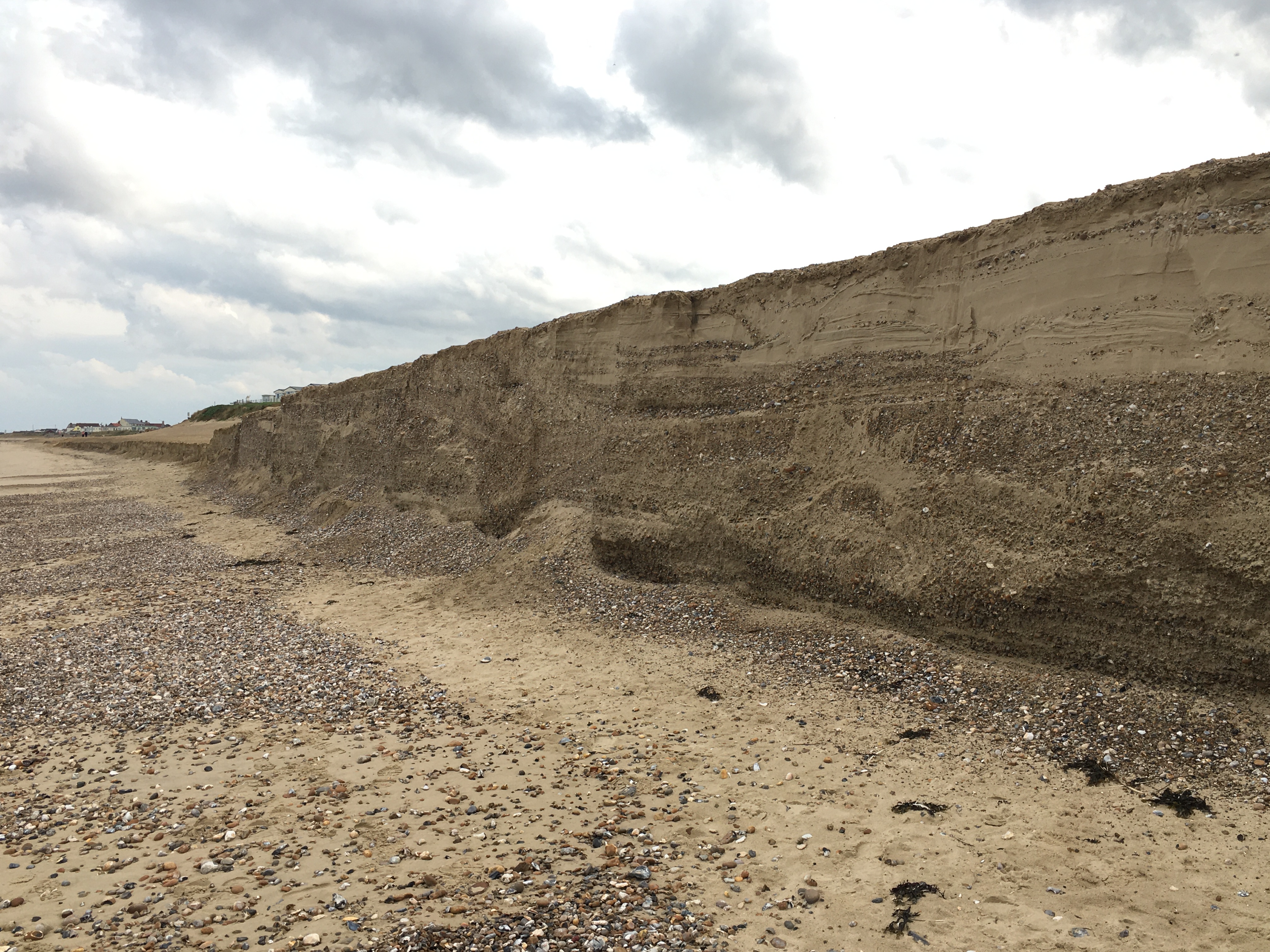
Sandscaping sediments at Bacton as exposed in 2020. Soon after their emplacement, the sea quickly began to reshape the beach profile to produce a marked c. 2m high cliff along much of the Sandscaping area. Artefacts contained within these sediments were quickly dispersed down-drift. (Photo: Simon Lewis)

A recently published, open access paper in Journal of Quaternary Science by Dr Rob Davis and PAB colleagues details a Middle Palaeolithic artefact assemblage that has recently been found on the newly replenished beaches between Bacton and Walcott, Norfolk. The paper describes the artefact assemblage and its spatial distribution and discusses its significance in the wider context of the British and European Middle Palaeolithic record. Among the paper’s co-authors are eight Norfolk residents who have been actively collecting artefacts and fossils on the beaches between Happisburgh and Bacton, and without whose diligent and persistent searching and recording we would not have such a detailed picture of this lithic assemblage and its spatial distribution.

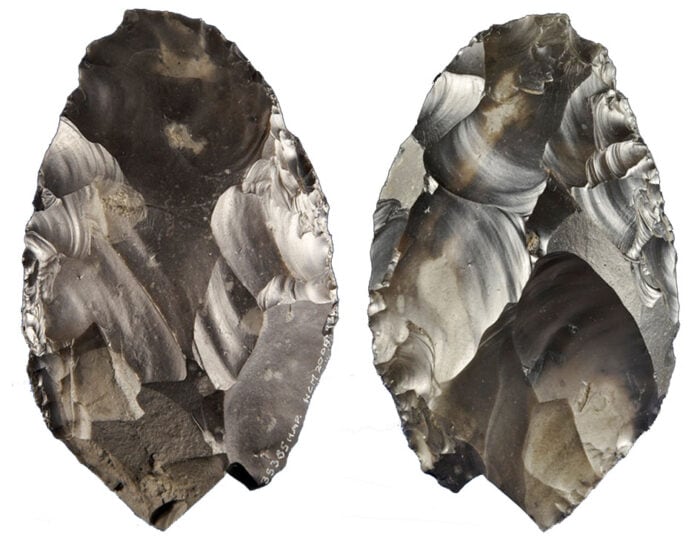
An example of a Palaeolithic artefact found on the beach after completion of the Sandscaping project at Walcott. This is a Levallois flake (dorsal view) and is stained and rolled, it also shows recent edge damage, most likely as a result of the dredging and beach replenishment process. (Photo: Simon Lewis)

The Sandscaping project emplaced 1.8 million cubic metres of sediments dredged from the submerged portion of the River Yare (the Palaeo-Yare) some 11km off Great Yarmouth to defend Bacton Gas Terminal as well affording some protection to the coastal communities in the area. The Sandscaping works were completed in late 2019 and it quickly became evident that these sediments contained Palaeolithic artefacts including distinctive Middle Palaeolithic flakes, cores and handaxes. A concerted phase of collecting activity followed, leading to the accumulation of over 850 pieces, most of which were geolocated using GPS units or mobile phones to record their position on the beach. The paper describes the artefacts and explores their significance for understanding human occupation of the region during the earlier Middle Palaeolithic. It is likely that the artefacts are from fluvial sediments deposited during Marine Isotope Stages (MIS) 7-6, some 200,000 years ago. The assemblage from the beaches at Bacton and Walcott therefore adds to our knowledge of neanderthal populations in the southern North Sea region in the later Middle Pleistocene.

The Sandscaping sediments are being reworked down-drift in a south easterly direction and have reached Happisburgh, all but concealing the foreshore exposures of the Cromer Forest-bed Formation, though inevitably on-going erosion and scouring of the beach does reveal these sediments from time to time. Artefacts from these dredged sediments have also been found on the beach at Happisburgh. Previous work by the research team, published in 2021, has demonstrated the potential value of beach finds at Happisburgh, so the arrival of this imported Middle Palaeolithic material is likely to further complicate Happisburgh’s Palaeolithic archaeological story.


If you would like to find out more about the Palaeolithic archaeology of the Norfolk coast you can view a virtual tour here or look at the Information and resources for collectors on the PAB website. This includes advice on what to do if you have found something on the beach that you think may be of interest and you would like to learn more about it. Previous beach finds from Happisburgh were reported by Bynoe et al. (2023). You can also learn more about Norfolk’s Ice Age past from the Deep History Coast project, and you can visit the Deep History Coast information panels located at various points along the north Norfolk coastline.

Categories: Happisburgh, Public engagement
Posted on July 31, 2023July 31, 2023 by Administrator

“These streets know travellers’ tales”

PAB researchers recently led a guided walk through the streets of Stoke Newington to explore Hackney’s distant past and the people who made the early discoveries

“These streets know travellers’ tales”. From a piece of street art on a building in Stoke Newington Church Street. (photo: Claire Harris)

London’s streets may seem an unlikely setting to explore the Palaeolithic and the lives of early humans some 300,000 years ago. However, there is much to be understood by simply walking through an area and getting a sense of the subtle changes in the topography and how some of the key locations fit into the wider landscape. Moreover, this part of north London has much to reveal about the lives of Hackney’s inhabitants many millennia ago. To mark the end of Hackney Museum’s exhibition “Hackney 300,000 years BC”, PAB researchers Dr Claire Harris and Professor Simon Lewis led a guided walk to explore this area and to tell the intertwined stories of its Palaeolithic past and the more recent history of discovery and collecting in the late nineteenth and early twentieth centuries.

A Queen Mary University of London Collaboration Fund grant enabled Claire Harris and Simon Lewis to examine the museum’s Palaeolithic collections and to develop resources to support their teaching of prehistory to the many school groups who visit the museum. Armed with a better understanding of the collections and their archaeological and historical significance the museum mounted the exhibition to display Palaeolithic artefacts from the area, including several impressive handaxes and faunal remains. The exhibition also highlighted the important contribution of those people who collected in the borough during the 1870s-1890s, when this part of London was undergoing a rapid transformation from quiet rural landscape to busy residential urban environment. This was a period of remarkable change, not only in the landscape of north London, but also in the emerging discipline of Palaeolithic archaeology. Thanks to the endeavours of Worthington George Smith, Joseph Exhall Greenhill and Samuel Hazzledine Warren, Stoke Newington has an important place in the early development of ideas on the antiquity of humans, their technology and the landscape in which they lived.

Abney Park Cemetery, once a collecting location for George Worthington Smith (a number of entries in his List of Palaeolithic Implements give the depths where artefacts were found in recently dug graves) and now the resting place of Joseph Exhall Greenhill. (photo: Simon Lewis)

So it was that seventeen hardy folk braved the rain on 22nd July 2023 to walk a route that took in several of Stoke Newington’s key Palaeolithic locations, starting in Abney Park Cemetery, with a stop at Greenhill’s grave. The next stop was Stoke Newington Common and Worthington Smith’s house in Kyverdale Road, from where he set about amassing a large collection of Palaeolithic artefacts from the foundations, sewer trenches and small gravel pits near his home and also developed his ideas on the “Palaeolithic floor” – an old land surface that he traced across the area and on which he found numerous Palaeolithic implements. The last three sites visited provided the palaeoenvironmental context for early human presence. One of Worthington Smith’s sites at Charnwood Street (formerly Caroline Street and the location of an old pit) yielded a molluscan fauna which indicated warm, riverine conditions during deposition of the Stoke Newington Sands, while in Evering Road remains of straight-tusked elephant and rhinoceros were found during sewer works in 1960. The last stop was on Hackney Downs, where boreholes for the Nightingale Estate development revealed organic muds containing mixed deciduous woodland pollen types including oak, alder, elm and hazel. Together these pieces of information allow archaeologists to understand the landscape, environment and chronology of human activity in the area and place these important discoveries in and around Stoke Newington into the wider picture of early human presence in Britain.

The walk concluded at Hackney Museum with an opportunity to view the exhibition for one final time and to reflect on Hackney’s distant past some 300,000 years ago as well as the Victorian antiquarians who put Stoke Newington on the Palaeolithic map.

If you want to find out more, a recent paper by Professor Mark White (Durham University) explores Stoke Newington’s archaeological significance and the people who collected there.

Categories: Pathways to Ancient Britain, Public engagement
Posted on January 14, 2022January 14, 2022 by Administrator

Are Genes Deep History?

In November, PAB researchers from Queen Mary University of London, in partnership with the Prehistoric Society, hosted an online panel discussion event as part of this year’s Being Human Festival. The topic – Are Genes Deep History? – was quite a challenging one for a mere two hours! Of course, all our panellists rose to the occasion with a thought-provoking, engaging, provocative (and quite entertaining) discussion and they did not shy away from the most difficult of topics including the relationship of DNA to identity, race, culture, migration, and narratives of the past.

The opening question from the chair, Mike Pitts ‘…what single advance or discovery in human genetic history has most surprised you?’ set the scene for the discussions to follow. Responses from the panel included the fact that the field exists at all, extracting DNA from sediments, its impact on traditional archaeological interpretations and the gap between what DNA does tell us and what it is thought DNA can tell us. And this was just the opening line!

It was agreed by the panellists that the speed at which DNA studies has progressed over the last two decades is astonishing, with traditional research almost playing ‘catch up’ to incorporate and make sense of the new developments in terms of archaeological interpretations and narratives. With this comes caution in how the genetic data marries with the archaeological data. One example which was discussed was population replacement, migration, and cultural shifts in the Neolithic.

One of the best quotes of the evening came from Professor Joanna Bruck, ‘…we need to engage in Slow Science…‘. It is the nuances and the integrity of the research that needs to be considered and communicated effectively rather than short, headline grabbing, sensationalist research. Leading on from this was a debate as to whether it is geneticists who need to become better historians (and archaeologists) or if it is the historians (and archaeologists) who need to be learning and engaging with the science.

One of the most thought-provoking discussions was around language. What words and phrases do we use to discuss and interpret archaeological and genetic narratives both within the disciplines and in communication to the public? How are they problematic? How do they need to change? As Subhadra Das pointed out, we talk about British Prehistory however, ‘…Britain did not exist in Prehistory…‘. The panel agreed that we lack the language necessary to describe what happened in the deep past as it is always influenced by our language today. 

Did you take it all in? There is a lot there! Did you miss it? Do you want to watch again? Catch up now!

https://www.youtube.com/watch?v=sDtHKua7sDY

Category: Public engagement
Posted on July 20, 2021August 23, 2021 by PAB Editors

Deep History Detectives weekend event at Happisburgh 

Over the weekend of 17th-18th July members of the PAB research team, Dr Claire Harris and Professor Simon Lewis, were once again at Happisburgh to run the Deep History Detectives weekend event. This event was the culmination of a five-month project funded by the Centre for Public Engagement at Queen Mary University of London. Through various sessions, it aimed to provide an opportunity for PAB researchers to meet people who were interested in learning more about the important Palaeolithic sites along the Happisburgh coastline, to share their knowledge and skills with participants, and to encourage them to get involved with the work of the Pathways to Ancient Britain team. Around 40 people attended one or more of the sessions which included a full-day flint knapping workshop, a taster knapping workshop, geological walks on the beach, and training in artefact identification and recording. 

The flint knapping workshops and demonstrations were led by experimental archaeologist Dr James Dilley. After an introduction to the basics of flint knapping, the participants were able to get “hands on” and have a go, first to learn how to remove flakes with a hammerstone then, as confidence and proficiency improved, at making a handaxe. Under James’s watchful eye and guidance, all the trainee flint knappers were able to make a handaxe. James also demonstrated other Palaeolithic tool making techniques, including an example of prepared core Levallois working to produce an excellent replica of a Levallois core and flake. The artefact identification session, led by Claire Harris, introduced the participants to the basics of artefact recognition, combining a short practical demonstration, led by James, then transferring this knowledge to look at material collected from the Happisburgh coastline. Participants learnt how to recognise the key features of a humanly-struck flake and how these can be distinguished from either natural percussion or thermally fractured flakes.

Geology beach walk at Happisburgh
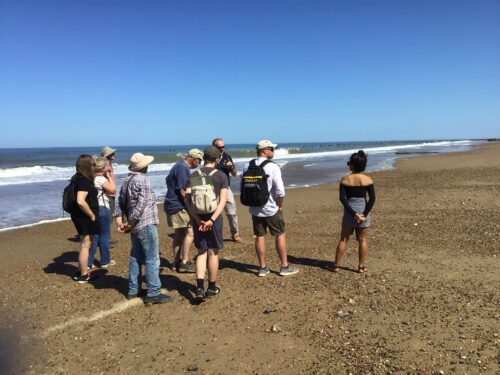
Geology beach walk led by Prof Simon Lewis. Photo: Dr Ian Parker Heath.

For those who wanted to learn more about the geology of the Happisburgh coastline, a geological walk, led by Simon Lewis, introduced the participants to the geological succession that can be seen on the beach at Happisburgh. The unpredictable build-up and removal of sand from Happisburgh beach, conspired to cover up most of the important sediments relating to the archaeological sites at Happisburgh, but it was still possible to tell the story of early humans at Happisburgh and also highlight the importance of on-going work by collectors who visit the area on a regular basis and how this knowledge, when shared with PAB researchers, can add greatly to our understanding of Happisburgh’s archaeological story. There was also the opportunity to discuss the likely impact of movement of material down the coast as a result of the recently-completed Sandscaping project between Walcott and Bacton.  

The main aim of the weekend was to provide new knowledge and skills relating to Happisburgh’s Paleolithic story. It is hoped that, armed with this new knowledge and understanding, our Deep History Detectives will continue to visit the area and be better able understand the geological and environmental evidence that can be seen on the beach and to identify and record Palaeolithic artefacts that can contribute to on-going research on the Happisburgh coastline. 


Categories: Happisburgh, Pathways to Ancient Britain, Public engagement
Posted on December 14, 2020August 23, 2021 by Administrator

The Happisburgh Handaxe 20 Years On

2020 marks twenty years since the first of a series of archaeological discoveries that have made Happisburgh a site of great importance in the British Lower Palaeolithic. The Happisburgh handaxe was found by a Norfolk resident walking the beach between Happisburgh and Cart Gap.

Palaeolithic handaxe from Happisburgh.
The handaxe that started it all! Discovered in 2000 this was the first beach find to be recovered from a dateable context. Rights Holder: Norfolk County Council. Licensed under a Creative Commons Attribution 2.0 Generic License.

The handaxe was found in situ; embedded in the Pleistocene sediments that were exposed at low tide on the Happisburgh foreshore. Realising its significance, the finder reported its discovery and researchers were quickly able to visit the site and make some important observations on the deposits that the handaxe came from and their relationship to the glacial sediments exposed in the cliffs. Among the first on the scene was John Wymer, who recorded in his notebook a visit to Happisburgh with Peter Robins and Jim Rose with accompanying photographs of the handaxe and the deposits themselves. Wymer records subsequent visits later in the same year and again in May 2001, when a team of researchers from Royal Holloway University of London sank boreholes and dug trenches to establish the stratigraphy and recover material for analysis.

Three years later the site was excavated by a team from the Ancient Human Occupation of Britain (AHOB) project. Excavating the deposits in the inter-tidal zone proved challenging but productive as a small assemblage of artefacts was recovered together with faunal material. This was followed by excavations by the University of Leiden working with the AHOB team, which added to the artefact assemblage and provided significant new palaeoenvironmental information. The handaxe could now be shown to have been found in organic muds laid down during an interglacial some 500,000 years ago. These results have been recently published in Quaternary Science Reviews. 

During the 2004 excavations, a survey along the beach led to the discovery of what became known as Site 2 and, in the following year continued exploration led to the discovery of Site 3 (the locality excavated in 2004 becoming known as Site 1). Site 2 afforded little opportunity for extensive excavation; though a small excavated area yielded a handaxe from deposits immediately beneath the Happisburgh Till. Site 3 on the other hand offered the greater scope for excavation and each summer between 2006 and 2012 archaeologists could be found digging the sediments and sieving them in the sea to recover flint artefacts and faunal and floral remains. The faunal assemblage, in conjunction with palaeomagnetic evidence, led the researchers to conclude that the site dated to around 850,000-900,000 years ago, making it the earliest evidence of human presence in Britain. 

Photograph showing sediments at Site 1.
Happisburgh Site 1 exposed at low tide in October 2020 (photo: Simon Lewis/PAB Project)

More archaeological information was revealed as the sea continued to erode the Pleistocene sediments. In 2013 a member of the research team was conducting a geophysical survey and noticed a particularly distinctive surface of the laminated sands and silts exposed by the waves near the old step tower. Closer inspection suggested they might be footprints, so a team was quickly assembled who returned to the site, in appalling weather conditions, to record the footprint surface before it was washed away. Analysis of the photographs showed beyond reasonable doubt that they were indeed human footprints and the size of the impressions indicated that they were left by a group of people ranging from adults to small children, who had walked across the soft mud flats around 850,000 years ago. These findings were published in PlosOne. Similar, but smaller, footprint surfaces were exposed in 2018 and 2019 in the same area. 

Approaching the end of the year is often a time to look back and reflect on past events, and perhaps this year more than most. It is interesting to ponder that so much of what we now know about the earliest humans to enter Britain stems from a chance discovery on a Norfolk beach. The Happisburgh story hasn’t ended, the coastline is still the subject of research and collecting activity and no doubt 2021 will bring more new information to add to what we already know and perhaps change our understanding of our distant past one more time.

Categories: Happisburgh, Pathways to Ancient Britain, Public engagement
Posted on October 28, 2020August 23, 2021 by PAB Editors

Community Beach Sieving Event

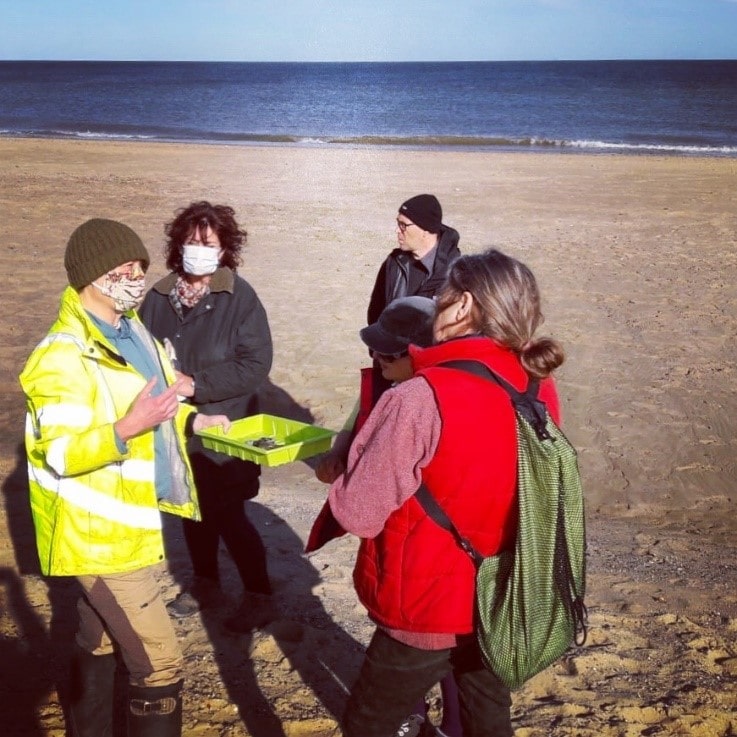
This Sunday saw our first Community Beach Sieving Event at Bacton. The event was planned, with the support of North Norfolk District Council, as part of our Palaeolithic Artefact Discoveries from the Sandscaping area (PADS) Project and we hope that it will be the first of several community events – pandemic permitting.

We couldn’t have hoped for better weather for our first community event and we were joined by two enthusiastic groups of volunteers – a mix of experienced collectors, faces we recognised from previous events that we’d run locally, and some complete beginners.

Since the emplacement of the 1.8 million cubic metres of dredged material on the beach between Bacton and Walcott in 2019, the beach profile has been modified by wave action. As the beach has been reshaped it has become a favourite spot for local collectors to visit and their careful beach walking efforts have been repaid by a large collection of Palaeolithic material. The sieving event was designed to take advantage of the wave cut ‘cliff’ features to study the structure, composition and artefact density of these deposits. Establishing the density of artefacts within these deposits and any variations across the Sandscaping area, provides us with useful data alongside the large number of artefacts that have already been reported.

During the two 90 minute sessions on Sunday we sieved around 2.5 cubic metres of the deposit, this yielded one possible artefact, a small struck flake. While this is a small return for the effort it does point to a sparse presence of artefacts within the beach deposits. It also highlights the value of collecting from the beach surface where artefacts may be more visible and larger surface areas can be searched and does contribute to our knowledge of these dredged deposits.

Although the Sandscaping deposits offer a unique research opportunity we are well aware of the power of the North Sea to reshape the coastline – the ‘cliff’ features in the Sandscaping deposits bear witness to the sea’s power. Many of the Pathways to Ancient Britain project team have worked along this coastline for the best part of two decades and the last thing that we would want to do is to negatively impact the communities we have received so much support from. All the material, bar the one possible artefact, was left on the beach to be redeposited by the waves.

The Palaeolithic Artefact Discoveries from the Sandscaping area (PADS) Project is funded by North Norfolk District Council and is currently set to run for six months, from September 2020 to February 2021.

Categories: Happisburgh, Pathways to Ancient Britain, Public engagement
Search PAB
Recent News & Updates
  • 400,000-year-old Neanderthal Fire-Making Technology December 10, 2025
  • The Quest for Fire December 10, 2025
  • A Big Puzzle: the refitting of a burnt handaxe from Barnham December 10, 2025
  • Summer 2024 excavation at Devereux’s Pit December 10, 2024
Follow @PathwaysAB

PAB is a collaboration between institutions including:

Pathways to Ancient Britain Institution Logos

Home | About | Blog | Barnham Excavations | Happisburgh Area | Contact

Copyright © 2025 Pathways to Ancient Britain Project

© Pathways to Ancient Britain 2025
Privacy PolicyBuilt with Storefront.