
Introduction
The earliest evidence of humans living in northern Europe dates to just under one million years ago. We are studying these sporadic occupations, mainly at sites in East Anglia and focusing on Happisburgh in Norfolk. These sites are proving to be critical in understanding how early humans adapted to the colder climates of northern latitudes.
Go straight to:
- Previous and Ongoing Work at Happisburgh
- Publications
- Additional Happisburgh Videos
- Further Information
Previous and Ongoing Work at Happisburgh
With continuing erosion of the coast, our work at Happisburgh has concentrated on monitoring and recording new exposures. Five principal sites have been discovered at Happisburgh. These include the oldest archaeological site in northern Europe and what may be the world’s oldest underwater archaeological site.
Happisburgh Site 1
Site 1 lies one kilometre south of the village of Happisburgh. At 500,000 years old, it may be the youngest of the five archaeological sites. Fieldwork suggests the presence of a slow-moving river and marshland at this site. Human occupation is indicated by handaxes, worked flint flakes and butchered bison and deer bones. The rich biological remains reflect a cool interglacial environment with birch and coniferous forest.
Happisburgh Site 3
At approximately 900,000 years old, Site 3 is the oldest archaeological site in northern Europe. It is notable for its excellent organic preservation of beetle, plant and mammal remains. In 2013 the earliest known human footprints in Europe were discovered just to the south of the site.
Site 3 consists of a complex series of channels cut by a slow-flowing river that was close to its estuary. The river was bordered by grassland and surrounded by conifer-dominated forest.
Human presence at the site is indicated by worked flint flakes and footprints. Winter temperatures may have been at least three degrees Celsius colder than today, but the presence of footprints from what may be family groups and children suggests that the humans at Happisburgh were year-round occupants and able to cope with the long, cold winters.
Footprint size indicates that the tallest individual was about 1.7 metres (5 feet 8 inches) in height. This is consistent with skeletal evidence of the average male Homo antecessor from the broadly contemporaneous site of Atapuerca in northern Spain.
Since 2013 there have been few opportunities for excavation due to high beach sand. Most of the work therefore has involved regular monitoring for new exposures with the help of local volunteers, whose finds are now being systematically recorded.
Happisburgh Site 5
This offshore site was first identified through the recovery of blocks of iron-concreted gravel from local beaches. These blocks contain plant remains, butchered bones and stone tool evidence. The mammalian fauna found in the blocks suggests that the site dates to the early Middle Pleistocene. Pollen and plant remains indicate a temperate environment.
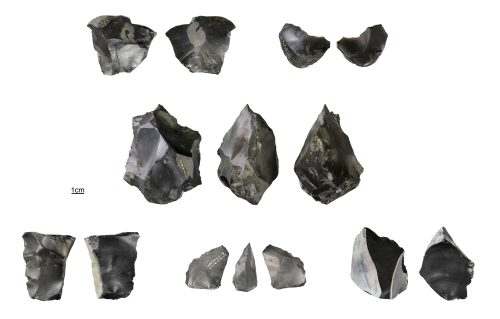
The gravel blocks were transported from offshore to local beaches by tidal action. The exact location of Site 5 is still under investigation through diving expeditions.
Various methods for locating Site 5 have been trialed and developed by a dive team from the University of Southampton from 2012 to 2015.
After a few weather-related setbacks, the final dive of the 2015 season saw the identification of in situ, outcropping deposits on an area of seabed known locally as the Monks. The same location also yielded the first fossil find of the dives, a heavily mineralised rhino leg bone. It is possible that this is the broad location of Site 5.
Further dives, in conjunction with geophysical techniques such as side-scan sonar and sub-bottom imaging, will be attempted in the future. If confirmed through diving and sampling, Site 5 would be the world’s oldest underwater archaeological site.
Publications
Ashton, N., Lewis, S. G., De Groote, I., Duffy, S. M., Bates, M., Bates, R., … & Stringer, C. (2014). Hominin footprints from early Pleistocene deposits at Happisburgh, UK. PLoS One, 9(2), e88329.
Davis, R., Ashton, N., Bynoe, R., Craven, J., Ferguson, R., Gardiner, I., Grimmer, T., Harris, C., Hatch, M., Johnson, C., Leonard, J., Lewis, S., Nicholas, D. and Stevens, M. (2023) Middle Palaeolithic occupation of the southern North Sea: evidence from the sandscaping sediments emplaced on the beach between Bacton and Walcott, UK, Journal of Quaternary Science, 38(6), pp. 866-890.
Bynoe, R., Ashton, N., Grimmer, T., Hoare, P.G., Leonard, J., Lewis, S.G., Nicholas, D., Parfitt, S.A. (2021). Coastal curios? An analysis of ex situ beach finds for mapping new Palaeolithic sites at Happisburgh, UK. Journal of Quaternary Science, 36, 191-210.
Farjon, A., Horne, D.J., Parfitt, S.A., Buckland, P.I. and Lewis, M.D. (2020). Early Pleistocene conifer macrofossils from Happisburgh, Norfolk, UK, and their environmental implications for early hominin occupation. Quaternary Science Reviews, 232, p.106115.
Lewis, S. G., Ashton, N., Field, M. H., Hoare, P. G., Kamermans, H., Knul, M., … & Sier, M. J. (2019). Human occupation of northern Europe in MIS 13: Happisburgh Site 1 (Norfolk, UK) and its European context. Quaternary Science Reviews, 211, 34–58.
Lewis, S.G., Ashton, N., Hoare, P.G., Parfitt, S.A., (2019). Human occupation of Northern Europe in MIS 13: a response to comments by Gibbard et al. (2019). Quaternary Science Reviews.
Parfitt, S. A., Ashton, N. M., Lewis, S. G., Abel, R. L., Coope, G. R., Field, M. H., … & Stringer, C. B. (2010). Early Pleistocene human occupation at the edge of the boreal zone in northwest Europe. Nature, 266: 229-233.
Ashton, N., Lewis, S. G., Parfitt, S. A., Bates, M. R., Bates, R., Dix, J. K., … & Sturt, F. (2018). Understanding and Monitoring the Cromer Forest-bed Formation. Historic England Research Report: Series no. 62-2018.
Additional Happisburgh Videos
Further Information
Our other Happisburgh pages: